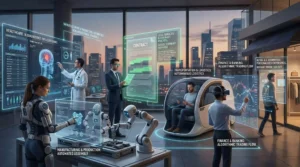
7 AI-Future-Proof Industries You Can Start Your Career In Now.

2.Complex Systems Architecture & Enterprise Software Engineering
AI coding assistants can generate isolated functions and refactor code, but they stumble when confronted with enterprise-scale software engineering. Building large, resilient platforms requires complex systems architecture, microservices orchestration, and deep database design that models complex real-world logic.
Modern full-stack developers are transitioning into software architects. They spend less time writing boilerplate code and more time designing scalable database schemas, orchestrating API gateways, and managing infrastructure state. Navigating legacy codebases while introducing modern frameworks like React and Node.js requires contextual awareness AI lacks.
Furthermore, debugging distributed systems requires tracking non-deterministic errors across decoupled microservices. An LLM cannot easily diagnose why a specific state hydration failure occurs only under specific network latency conditions.
Enterprise software involves cross-functional negotiation among product managers, security compliance officers, and infrastructure teams. Translating vague human business requirements into production-ready software specifications remains an inherently human capability.
- Schema Engineering: Designing normalized and denormalized database schemas optimized for high-throughput, low-latency applications.
- Full-Stack Orchestration: Integrating asynchronous Node.js backend services with complex, reactive frontends built on React.
- Edge-Case Debugging: Resolving transient, non-reproducible infrastructure errors across multi-cloud enterprise deployments.
The era of the code-monkey is officially over, but the era of the high-leverage systems architect has only just begun.