7 Ways AI is Revolutionizing Modern Healthcare
5. Increasing Precision in Robot-Assisted Surgery
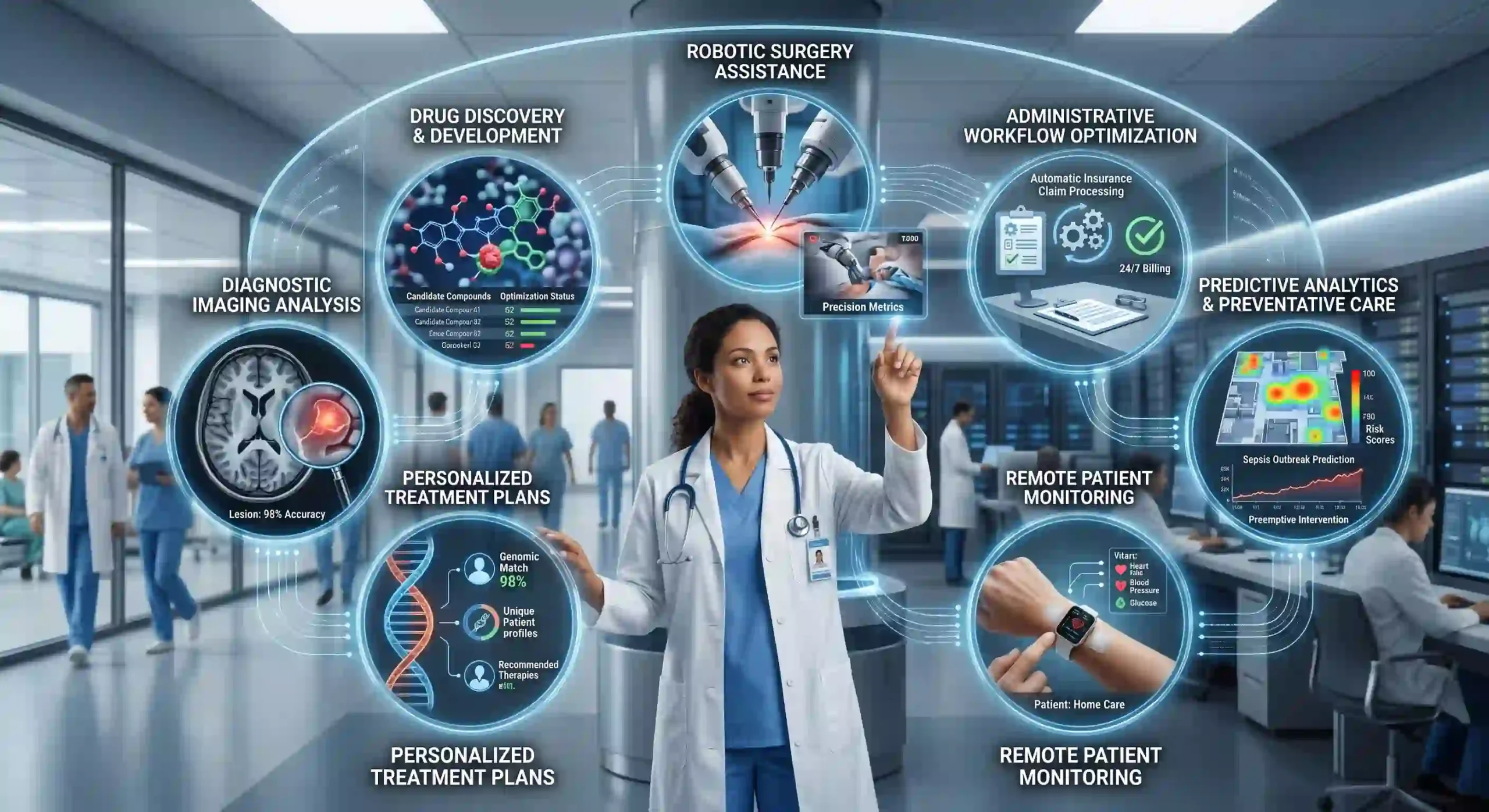
Robots have been used in surgical settings for years, typically through teleoperated systems (like the da Vinci surgical system) where a surgeon controls highly precise instruments from a console. The next revolution, however, integrates AI into these systems, moving them beyond pure mechanical precision toward intelligent assistance.
AI is providing surgeons with augmented capabilities during complex procedures:
- Real-time Guidance: While a surgeon is performing a laparoscopic procedure, an AI model can analyze the video feed in real-time, overlaying a virtual “map” that identifies critical anatomical structures, blood vessels, or tumor boundaries that might be obscured by tissue.
- Procedural Skill Evaluation: AI can analyze a surgeon’s kinematics (hand movements) and decisions during robotic surgery, providing standardized feedback, identifying areas of inefficiency, and suggesting optimizations to improve procedural speed and safety.
- Autonomous Tasks: Researchers are developing AI systems that can semi-autonomously perform routine, repetitive tasks such as suturing or cutting with superhuman consistency, allowing the lead surgeon to focus on the most critical parts of the procedure.
AI-assisted systems are not removing the surgeon; they are providing them with enhanced visual acuity, steadier hands, and a level of digital wisdom that enhances patient outcomes.